IEE S.A., a world leader in smart sensing solutions for automotive and other markets, is proud to announce that it has been awarded the prestigious FEDIL Innovation Award 2024 in the “Product” category. The award recognizes IEE’s groundbreaking innovation: the Laminated Busbar Connector for batteries of electric vehicles (EV) or energy storage facilities.
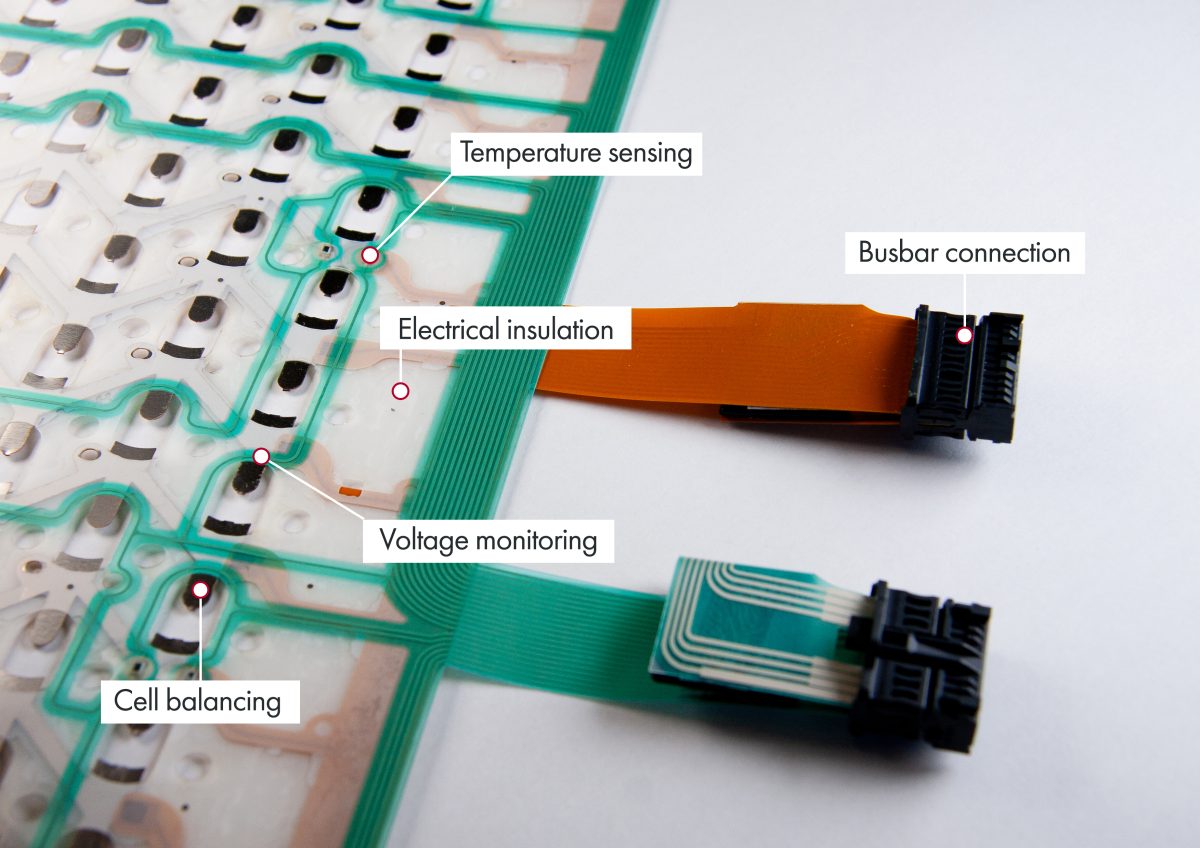
The Laminated Busbar Connector is a compact, lightweight hybrid solution combining printed electronics with traditional electronic assembly elements. This revolutionary product integrates multiple functionalities—such as voltage monitoring, cell balancing, temperature sensing, electrical isolation, and busbar connection—into a single component. The innovation simplifies battery design, increases automation in manufacturing, and reduces production costs, ultimately making electric vehicles more affordable and accessible to a broader audience.
“We are incredibly proud of this achievement and this award is a testament to the dedication, creativity, and teamwork that have driven the development of the Laminated Busbar Connector” said Michael Olk, Business Development Manager at IEE. “Our cross-functional teams in Luxembourg have worked tirelessly to create a product that pushes the boundaries of innovation. We are excited to continue collaborating with the automotive and energy industries on solutions that contribute to a more sustainable future.”
By reducing the need for traditional cabling, the Laminated Busbar Connector saves space within the battery pack, allowing more room for electricity charging cells, which in turn enhances the driving range of electric vehicles. Its customizable design also extends the benefits to energy storage and industrial battery systems, further contributing to a sustainable future.
“We are honored to receive the FEDIL Innovation Award 2024 in the Product category,” said Alain Schumacher, Chief Technology Officer of IEE. “This recognition highlights our commitment to developing cutting-edge solutions that do not only drive technological progress but also create tangible benefits for the environment and society. The Laminated Busbar Connector is just one example of how IEE is innovating to shape the future of electric mobility and energy storage.”
IEE continues to lead the charge in smart sensing technologies, pioneering solutions that support the global energy transition and a sustainable mobility.
We offer a complete range of sensing and heating solutions to improve the safety and durability of your battery safety pack.
Congratulations also to the other awarded companies:
Husky Technologies for its “Plate Line Automation” project (category: Process)
Creos Luxembourg S.A. / DataThings S.A for their project “Kopr: The AI Twin of the Smart Grid” (category: Data / AI)
CTI Systems S.à r.l. / Gradel S.à r.l. for their “On Board Cargo Loader” (category: Engineering Excellence)
Talking to: Thierry Mousel – Marketing Manager/Global Regulatory Strategist“At IEE, we do not shy away from business opportunities that may initially look niche, and we recognize their potential for growth. We always strive to give a tangible meaning to our company slogan “A sense for innovation” that translates into viable solutions for the industry.”
Thierry, you have been working for IEE for over 20 years now. What is IEE and what is your role within the company?
IEE is specialised in sensing solutions for various markets. Automotive is our biggest market, but we also provide sensors for building management or medical & healthcare applications, based on various sensing technologies.
My core task is to monitor and analyse worldwide evolutions related to vehicle regulations or vehicle safety assessments (e.g. NCAP vehicle safety ratings). I represent IEE in the corresponding technical working groups, and share my findings with our Business Lines, Business Accelerators and the sales team. My work helps IEE to better understand the future customer needs and to develop the appropriate sensing solutions that will be required in the coming years. In addition to those regulatory tasks, I manage our Marketing & Communications team.
What do you see as the biggest challenge in your work?
I develop strategies to make our interests heard, and a constant challenge is that one has to accept these are often mid- to long-term activities. A quick success is rather the exception than the rule, especially when it comes to novel vehicle safety functions. It can easily take 15-20 years from the introduction of a new technology until it finds its way into the mass market. So, often, it takes some perseverance to achieve one’s goals!
What are you particularly proud of?
My work contributes to saving lives, and that’s something I think I can be proud of. Two examples: Seat belt reminders are known to reduce crash fatalities and injuries, as they increase the seat belt wearing rates. I have been a key industry representative in the United Nations working group that created a regulation for seat belt reminder systems. Such systems will become mandatory on the front seats of new vehicle types from September 2019 onwards in the EU, Japan, South Korea and other countries.
Another topic that I’ve been dealing with since quite a while is children dying of in-vehicle heatstroke. I’ve been monitoring and analysing this issue for more than 10 years. IEE has finally found a solution to detect even sleeping infants who are left unattended in a vehicle. So, I now strongly hope that VitaSense – our dedicated product – will considerably help save children’s lives.
What do you most like about your job?
The fact that I am continuously involved in new topics. When I started to work for IEE, the key vehicle safety topic was passive safety (reduction of fatalities). Then active safety (prevention or mitigation of crashes) gained in importance. Today, the topics of assisted and automated driving are strongly in the regulatory focus. And the various worldwide NCAP’s also tend to evolve at an increasing pace. No year is ever the same, and in each of these areas there are and have been opportunities for IEE. On top, attending international working groups allows me to meet people from all around the world, which is a very valuable personal experience.
IEE pioneered the development of occupant presence detection sensors more than 25 years ago. Since then, we have developed various vehicle interior sensing solutions based on different technologies. We have a history of being “first to market” with innovative solutions: Child Seat Presence and Orientation Detection (CPOD), capacitive occupant classification (BodySense), capacitive “hands-off” detection (HOD). And with VitaSense, we now have another promising technology in the pipeline.
In the non-automotive markets, we also realised major innovations: our 3D MLI sensor for building management had been honoured for its benchmark performance. At IEE, we do not shy away from business opportunities that may initially look niche, and we recognize their potential for growth. We always strive to give a tangible meaning to our company slogan “a sense for innovation” that translates into viable solutions for the industry.
Autonomous Car Pilot Project in SchengenIEE present at the opening
A confirmed leader for automotive sensing solutions, IEE participated in the “Cross-Border Digital Testbed Project Day” supporting autonomous driving testing.
Autonomous driving and border crossing were high on the agenda yesterday, 3rd April 2019, in Schengen, Luxembourg, where the “Cross-Border Digital Testbed Project Day” kicked off. As a confirmed leader for automotive sensing solutions which is also heavily involved in R&D and the exploration of new applications and technologies, IEE displayed the capabilities of its sensors in the presence of Luxembourg, France and Germany officials.
A 206 km circuit has been jointly opened by the three countries to enable testing the car of the future. Such innovations prepare the ground for a different level of mobility which, as the Deputy Prime Minister of Luxembourg and Minister for Economic Affairs, Étienne Schneider, reminds, will bring significant changes to the European landscape. They are intended to contribute not only to facilitating traffic conditions when crossing from one country into the other, but also improve driving safety, energy efficiency and air quality.
“Safety and innovation in driving truly lie at the heart of our business,” says Michel Witte, Chief Executive Officer at IEE. Our R&D teams are pro-active in designing new car sensor technologies while we constantly work with our customers to understand their present and future needs and help them meet legislation requirements. Whenever there is an opportunity for vehicle improvement, we put our expertise into use to deliver sensors that fit the industry trends,” says Witte.
The choice of the location for this pilot project is by no means a random one. Schengen is where Europe without borders first saw the daylight. The symbolism for freedom of movement thus extends to technological progress, which sees no barriers or borders.
Scared of autonomous driving? The shift is not likely to happen before 2030-2035, but in the automotive world, changes take place at an extremely rapid pace and it is best to be prepared and welcome the self-driving car.
“At IEE, we are all about innovation, and being present at such an event during which the future of mobility is discussed and initiated through autonomous car testing is only natural. We embrace change and look into the future,” says Alain Schumacher, Chief Technology Officer at IEE.
Need a customized solution?
If you want to talk about customization options, price, availability or other related to this product